Building the Australia We WantInterim insights from the National Conversation Development Lab
Early thinking from the first design cycle. Nothing here is final. Every part of it is open to challenge, and the questions throughout are genuine requests for your input.
About this report
This report shares early thinking from the first design cycle of the National Conversation Development Lab. Foundations for Tomorrow has convened the Lab as a collaborative design process to develop and test a model for a National Conversation about Australia's long-term future.
About
This work is made possible by the more than 260 partners and experts who have contributed their time and thinking to the Lab. What follows is a shared effort of the Lab's many contributors. It reflects many voices and is not always the agreed position of any one of them.
The report sets out the emerging design, the questions participants raised and the early ideas in development. It opens the work to people who have not been part of the Lab, so they can weigh in and share feedback while the thinking is still easy to change.
Nothing in these pages is final. Every part of it is open to challenge. The work is offered in the spirit of collaboration, with a commitment to build on what already exists and avoid duplicating effort wherever possible.
Foundations for Tomorrow
FFT works to equip leaders, across sectors, communities and generations, with the tools and insights to embed long-term thinking into governance, policy design and decision-making.
It is driven by a generational vision of a resilient, inclusive Australia where leaders make decisions that safeguard the wellbeing and prosperity of current and future generations.
Contributors and partners
More than 260 partners and experts have contributed their time and thinking to the Lab.
Who wrote it
Authors: Taylor Dee Hawkins and Emi Hall
Core Team: Tanisha Frescon, Matthew Day, Zali Fisher, Clare Beaton-Wells, Ella Kay
Core advisors: Tristan Schultz, Keeva Stratton, Rachel Bacon, Richard Holden and Martin Stewart-Weeks
Who oversees it
Governance Council: Rana Ebrahimi, Hon Karen Andrews, Iain Walker, Charlotte Mortlock, Aleem Ali, Chelsea Hunnisett and Jason Glanville
First Nations Data Sovereignty: Skye Trudgett, Lisa Rapley, Elfie Shiosaki, Tanisha Frescon and Ahna Maree Barker
Intercultural Engagement and Ethics: Parviz Deamer, Zahra Al Hilaly, Mark Yettica-Paulson, Mark Zirnsak, Jason Glanville and Nayonika Bhattacharya
The full list of Lab members and partner organisations is published on the team page.
The partners making the Lab possible.
What the six Development Tracks have produced
Government and policy integration
Making the National Conversation and its outputs valuable, feasible and politically desirable to adopt and implement.
Scaled Impact Plan. The value created with or without a full National Conversation.
Research design, data and ethics
Building the methodological foundation that makes the Lab's work defensible to participants, communities and policy makers.
National Research Ethics Application (in development), integrating protocols shaped by both subcommittees.
Engagement design and technology
Working out what makes participation trusted, engaging and effective.
Menu of in-person and digital engagement options.
Success criteria for a National Conversation.
Community-led design
Designing a model that honours local leadership while producing nationally cohesive outputs.
Commissioning and delivery models that could make a National Conversation credible and effective.
Accessibility and inclusion
Designing the pathways that overcome the structural barriers that too often define who can take part.
Universal Design Ladder.
Universal Design for Civic Engagement.
Public engagement
Developing the narrative for the National Conversation, in language that works across generational, cultural and political differences.
Explaining the National Conversation.
Who a National Conversation has to reach, ten public profiles.
Prototypes being tested with participants
Criteria deck
A card deck for selecting decision-making criteria and working through the tensions between them.
Architecture for a National Conversation
The wider model, drawing on insights gathered across all six tracks.
Introduction
The purpose of sharing these preliminary insights.
A National Conversation can only work if it is built with the people and organisations it is meant to serve, not handed to them once finished. That is why the Lab's design process is collaborative and open by intention. Much good work already happens across Australia, and we want to build on it, not duplicate it. Sharing very early work, before it is polished, lets us bring people with us.
What follows is early thinking from each of the six Development Tracks: the tensions that remain open, the assumptions being tested, the options still on the table, and the questions where we need help.
You won't find recommendations or a finished model here, nor positions on any policy issue or views on what Australians should conclude.
How to read this report
The emerging design
A first sketch of what a National Conversation could be and what it could leave behind.
Go to Part 1 →Provocations
Four questions, and the tensions where the Lab most needs help.
Go to Part 2 →Prototype
The criteria deck, an early tool being tested with participants.
Go to Part 3 →Reference
A glossary, how the Lab is governed, and the sources behind this report.
Go to Part 4 →The design pathway
There will be four design cycles from August 2026 to mid-2027. Each builds on what the last one learned, so the model is tested at every stage before it reaches parliamentary leaders.
This report sits at the end of Cycle 1, alongside the Parliamentary Group meeting on 13 October 2026. Little in it has been tested yet. Workshop 2, on 17 and 19 November, is where testing begins. Research runs alongside Cycle 2, and roundtables and community pilots run alongside Cycles 3 and 4, so ideas are tried with communities before anything is finalised. A developed model is due to be released in August 2027.
Each design cycle takes what the previous one produced and puts it under pressure: first finding the gaps, then testing early insights, then stress-testing a draft model, and finally refining it for handover.
This report sits at the end of Cycle 1, alongside the Parliamentary Group meeting on 13 October 2026. Little in it has been tested yet. Workshop 2, on 17 and 19 November, is where testing begins.
Research runs alongside Cycle 2, and roundtables and community pilots run alongside Cycles 3 and 4, so ideas are tried with communities before anything is finalised.
A developed model is due to be released in August 2027.
The emerging design
Australians have experienced many ways to be consulted and few ways to shape long-term decisions together. Here is a first sketch of what a National Conversation could be, and what it could leave behind.
What a National Conversation could offer
- Engaging across divides. Generations, regions and communities often talk past each other. A National Conversation could make room for Australians to hear one another before anything gets decided.
- Reaching the full range of Australian experience. The design needs to reach people who rarely take part, not only those who always do.
- Strengthening community cohesion. A shared process for asking hard questions could help bridge divides, even where people land on different answers.
- Getting more from existing effort. Governments, councils and community groups already spend time and money consulting. A National Conversation could make that effort add up, so communities are not asked the same questions again and again.
The world feels more divisive than ever, and a National Conversation offers hope of bringing people together, across divides, to find common ground. It is an opportunity to disrupt patterns of binary and high conflict.
Lab contributor
Explaining the National Conversation
A plain account of what a National Conversation could be and what it would be for. These lines are drafts, being tested for whether they hold up in a sentence as well as in full.
A large-scale, structured, collaborative process that would bring together everyday Australians across generations, communities and regions to explore what matters most, identify what is shared, and build a common direction for the country.
Enabling all Australians to feel heard and shape a shared future.
All people living in Australia can look beyond today with a sense of common purpose and the confidence to have a say, feel heard and shape a future for their family, community and the country as a whole.
A way to ask Australians what we want for the future, and actually listen to each other.
To create a trusted process for Australians to define the principles and priorities that matter most for the country, and reshape decision-making to prioritise the long-term future.
To turn talk into a clear direction for a better future.
To turn community conversations into clear and usable directions for national decisions that respond to today's pressures while building for the long term.
The remit
A National Conversation would seek a clearer, shared account of how Australia should make the decisions that shape its future. The aim is a process Australians can accept even when they disagree with a result, because they agreed on how it was reached. Done well, it could strengthen the social contract.
Where public judgement stalls
Communities hold ambition and local insight. The Lab's starting view is that institutions lack a reliable way to draw on it.
Long-term decisions need public judgement behind them. Today that judgement stalls at three points on its way to a shared national direction. At each one, decision-makers have no agreed account of the ambitions of the public, so short-term pressures win.
Trust is short in both directions
Officials doubt the public can weigh complexity, and the public doubts the process leads anywhere. Social cohesion is under strain too. Between 2020 and 2025, the share taking great pride in the Australian way of life fell 14 points, to 34%, and 37% trust the federal government to do the right thing.
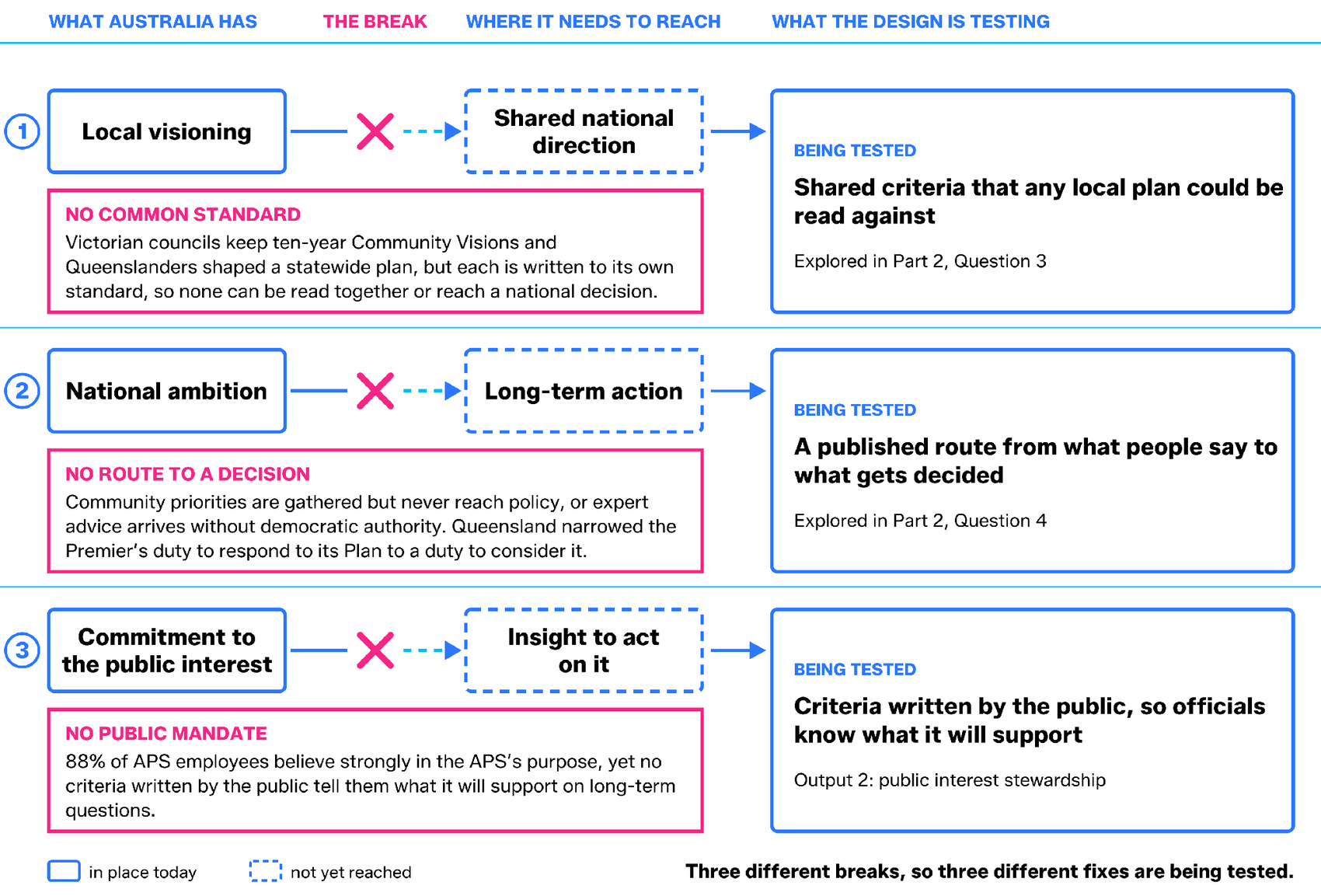
Figure 1. Public judgement stalls at three different points between what Australia has and where it needs to reach, and each break needs its own fix. Source: Track 2: Research design, data and ethics (2026).
The outputs
Translating national engagement into lasting impact.
National engagement often ends with a report, and the next effort can spend its first year rebuilding trust. Meanwhile long-term decisions stall in a cycle: governments lack an agreed account of what the public will support, officials take a personal risk when they engage, and people see little come of having a say.
The design starts from a different question: what should the country keep when a National Conversation closes? The working answer is three outputs, each designed to outlast the initial National Conversation.
Community visioning
An ongoing practice, not a fixed vision statement. People practise imagining a shared future and disagreeing well. The networks and civic capability this builds outlast any single decision.
Why it matters: designed to strengthen the public voice. A hard decision needs social licence, and people who have weighed a real choice together could become the social licence a hard decision can stand on.
Stays with the people who took partPublic interest stewardship
Communities define the public interest as criteria to guide long-term decisions, and the public service builds the capability to apply them.
Why it matters: designed to reduce the risk of acting. Officials would gain a public basis for frank advice, and leaders would gain informed public judgement that lowers the political risk of acting.
Carries into how decisions are madeDurable and adaptive governance
National coordination infrastructure, built over time as a public good, so public engagement can continue from the ground up.
Why it matters: designed to keep the investment going. Criteria written by the public carry no party's name, which should make them more likely to survive a change of government.
Builds lasting national infrastructureThis initiative is an investment in a thriving Australian democracy and is not intended to replace the important work of our Parliamentarians. A National Conversation could support clearer evidence of what the public will support, and the social licence to act on it. That benefit is not automatic. It depends on a process designed to find out what people think, not to win their endorsement, and on a commitment to respond to what it hears, even where the answer is no.

I could wallpaper my house with the amount of vision options I have been involved in creating.
Lab contributor
This is a chance to come together with others in your community and dream.
Lab contributor
The model
No single method can reach millions of people and weigh hard choices well, so the model combines several.
A first sketch, drawn from all six Development Tracks through the Architecture for a National Conversation, moves through three phases over time and works at three depths of engagement, called altitudes, at once. The public interest criteria run through all of it. Every box is a draft for the provocations to push against.
Orientation and grounding
What happens: information collection and co-creation of the criteria.
Who takes part: anyone, at every altitude: surveys, prompts, schools, community touchpoints, card activities and forums.
What it produces: what people prioritise and how they define the public interest, captured as criteria.
Synthesis and design
What happens: synthesis sets the criteria under governance rules published before any material is collected. Baseline questions are designed for each criterion.
Who takes part: the body appointed to synthesise, applying the published rules. How that body is chosen is still open.
What it produces: a set of criteria and baseline questions, with divergence reported as a finding.
Substance and debate
What happens: baseline questions are released at all three altitudes, reworded for policy areas such as housing, health and climate.
Who takes part: people at all three altitudes.
What it produces: ambitions, how we want to reach them, the strategies to make this possible, and how each criterion holds up across policy areas and trade-offs.
Design work alongside all three phases
Defined before or alongside Phase 1: governance, response commitments, inclusion and First Nations pathways, synthesis rules, audit, data stewardship and the interface with government.
Set before any material is collected for synthesis: mandate and appointment, coding and weighting rules, treatment of different participation streams and divergent findings, traceability for participants, independent review, oversight of automated analysis and accountability for the interpretation.
how we want to make decisions over the long term
a process around these criteria that builds capability
the criteria across depths of engagement (altitudes) and policy areas
Civic imagination'What matters most?'
Problem solving'What would we accept to get there?'
Institutional design'What makes it endure?'
Figure 2. Three phases, run at three altitudes, aim to produce three outputs.
- What happens
- Information collection and co-creation of the criteria
- Who takes part
- Anyone, at every altitude: surveys, prompts, schools, community touchpoints, card activities and forums
- What it produces
- What people prioritise and how they define the public interest, captured as criteria
- What happens
- Synthesis sets the criteria under governance rules published before any material is collected. Baseline questions are designed for each criterion
- Who takes part
- The body appointed to synthesise, applying the published rules. How that body is chosen is still open
- What it produces
- A set of criteria and baseline questions, with divergence reported as a finding
- What happens
- Baseline questions are released at all three altitudes, reworded for policy areas such as housing, health and climate
- Who takes part
- People at all three altitudes
- What it produces
- Ambitions, how we want to reach them, the strategies to make this possible, and how each criterion holds up across policy areas and trade-offs
Defined before or alongside Phase 1: governance, response commitments, inclusion and First Nations pathways, synthesis rules, audit, data stewardship and the interface with government.
Set before any material is collected for synthesis: mandate and appointment, coding and weighting rules, treatment of different participation streams and divergent findings, traceability for participants, independent review, oversight of automated analysis and accountability for the interpretation.
Figure 3. The three phases of the sequence. Each phase starts once the one before it has produced its result. Design work runs alongside all three, and Phase 3 findings can send the work back to an earlier phase.
Working at three altitudes
An altitude is a depth of engagement: how much context an activity can assume.
Each form of engagement trades reach for depth. A deliberative panel produces careful judgement from a few people, and the same design stops it scaling. A survey reaches many people, and cannot settle how to reach a goal. Reach falls as context rises. Working at three altitudes lets each contribute what only it can, while the criterion being tested stays fixed.
The working view is that a decision needs all three. Civic imagination sets a direction and ambitions, but cannot say how to reach them without time and information. Problem solving works out how to get there, but cannot design the institutions to carry it. Institutional design turns public input into durable and adaptive rules and bodies, but has no standing to set the direction. Each altitude therefore checks the others: a proposal that contradicts the direction set at a lower altitude would go back to that altitude before it is adopted.
Four draft rules govern what each altitude may ask
- Non-negotiables come first. Participants settle what must not be traded before they weigh any trade-off. Asking people to put a price on something they hold sacred produces outrage and no usable answer (Fiske and Tetlock 1997).
- No question presumes people go without essentials. No question asks participants to accept that others will go without a home, care or safety.
- Necessity before settlement. Problem solving records a tension as avoidable when better sequencing, cross-portfolio work or a longer horizon would remove it. A later decision that treats that tension as unavoidable can then be challenged.
- No cost at civic imagination. A cost is put to people only where they have the time and information to weigh it. Civic imagination therefore asks no trade-off questions.
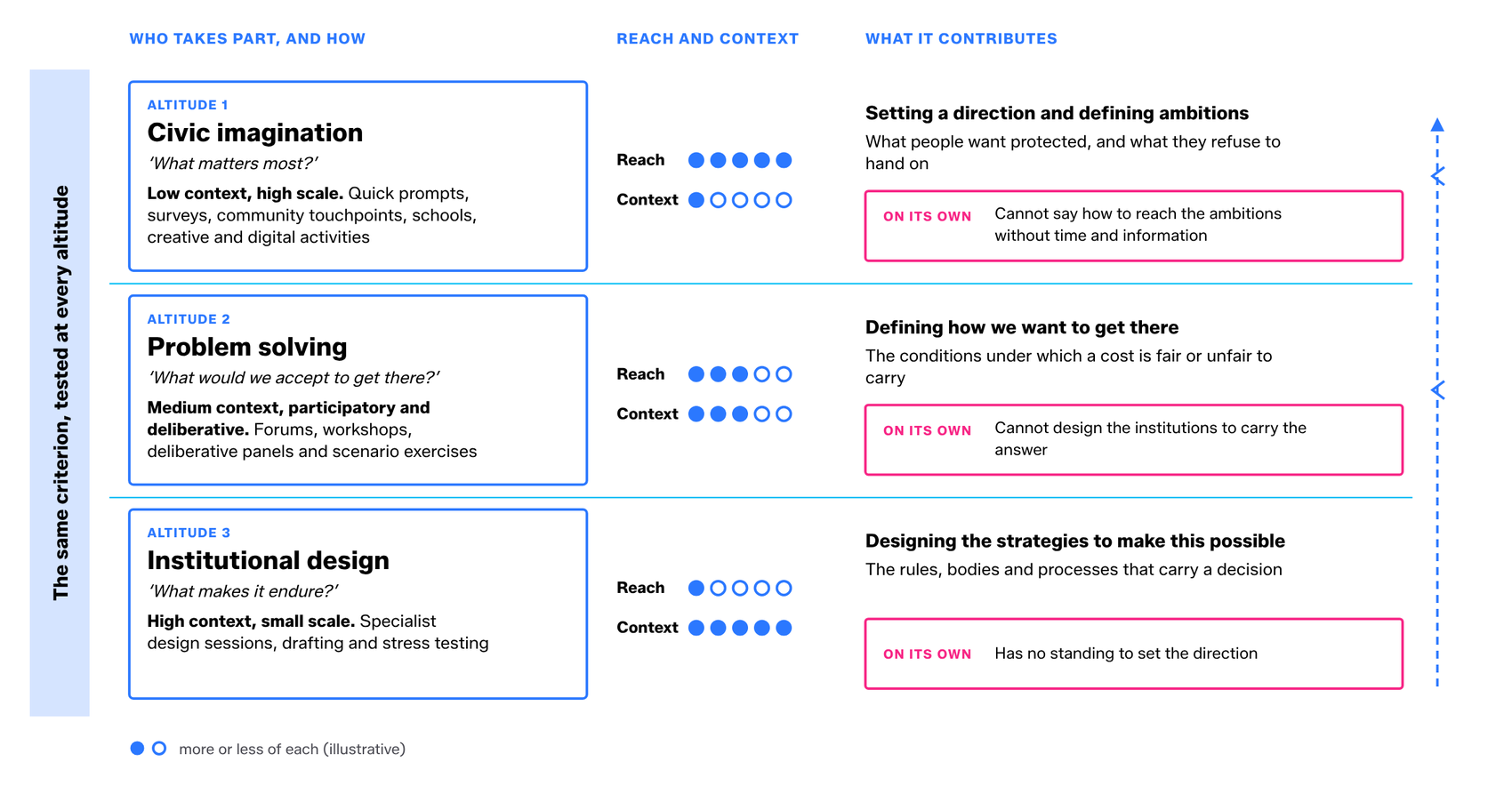
Figure 4. Reach falls as context rises, so each altitude contributes what the others cannot, and a decision needs all three.

Defining success
Defining success means holding two questions at once.
One looks at the initiative as a whole and the value it leaves behind. The other looks closely at each engagement and whether it was done well. Both matter, and they are measured differently.
Is the Lab worth doing?
Tracks what the initiative builds and where that could lead over years, not single events. Success here means the goodwill, time and expertise people invest leave communities, practitioners and governments better equipped than before: tested methods, trusted networks and capability they keep and use. The measure holds whether or not a full National Conversation goes ahead.
Did this engagement work, and did it count?
Sets a shared standard that every engagement is held to, from a Lab pilot in one community to a national deliberation. Each is judged on who took part, how well it served its purpose, what it left in people, whether its outputs can be trusted and what changed as a result.
Assumptions being watched
The map rests on three early assumptions, each still being tested: that relationships are the infrastructure of change; that showing something can work lowers the political risk of trying it; and that the conditions for leaders to act can be built by deliberate effort. The Lab is tracking its contribution to these outcomes, not claiming them as its own.
What the Lab leaves behind
The Lab's work should be worth doing even if a full National Conversation never happens.
This map traces what we are building now, what could follow if conditions allow, and the value that remains for communities, practitioners and governments on every pathway.
Methodological and relational outputs
Methodological. A tested methodology comprising governance arrangements, the architecture for a National Conversation, engagement methods and proposed criteria for the public interest.
Relational. Networks, trust and participation infrastructure: a national coalition of community organisations, civic leaders and youth networks, ready to sustain a National Conversation if it goes ahead.
The larger pathway, if conditions allow
Community visioning, public interest stewardship, and durable and adaptive governance: criteria defined by the public and tested across contexts, with national coordination infrastructure as a public good for engagement beyond the election cycle.
Value with or without the full process
Assets given back to community, practitioners and state and territory governments. Possible contributions to national reporting such as ABS data, the federal Budget, the Intergenerational Report and Measuring What Matters. Elevation of local leadership, and strengthened APS engagement capability.
Value created through participation, regardless of the final outcome
Network development and capability
Finding and connecting the hubs that already exist in universities, councils and community organisations, and building the coordination function to work with and through them.
Strong, connected communities
Strengthened trust and relational networks across generations, regions and communities, built through structured dialogue in which people can disagree without fracturing and differ without disengaging.
Civic agency
The confidence, cross-community perspective and collaborative habits people build by taking part, which help them engage with complex national trade-offs and connect local dialogue to national policy.
What successful engagement looks like
A National Conversation asks a lot of the people who take part and the institutions that commit to it, so success needs to be defined clearly before any engagement begins.
Reach and depth of participation
Who took part, and could they bring their whole selves to it?
Participant profile against ABS benchmarks, published with the shortfalls. Cohort participation reported on its own, not averaged into a national figure. Self-reported safety collected identically across formats, and a visible record of how complaints, withdrawals and distress were handled.
Efficacy of the engagement
Each engagement is assessed against the sub-criterion that matches its purpose, not against all three.
Civic imagination: did it reach people who would not otherwise have engaged, on their own terms, with room held for dissent?
Engaged citizens: was the outcome theirs, was it reasoned, and did it move anything? Those who disagreed still say they were treated fairly.
Resilient design: could the people who must build, fund, advocate or activate it shape the answer, with practicalities surfaced honestly?
What it leaves in people
Were people changed by taking part, and could they see where their contribution went?
Movement in stated positions, and whether people can name what shifted them. Warmth toward those who disagree, and connections still active at twelve months. How quickly people received a real response, and a published record of what was taken forward, what was not, and why.
Credibility, and change in the wider system
Is it believed, and did anyone use it when it told them something they did not want to hear?
Independent method review published in full, and aggregation methods published before results. Outputs that name disagreement rather than averaging it away. Instances where the criteria produced an inconvenient answer, and what happened next. Infrastructure that survives a change of government.
| Success criteria | What would show it |
|---|---|
| 1 · Reach and depth of participation Who took part, and could they bring their whole selves to it? | Participant profile against ABS benchmarks, published with the shortfalls, including whether it reached people who would not otherwise have engaged. Cohort participation reported on its own, not averaged into a national figure. Self-reported safety collected identically across formats, and a visible record of how complaints, withdrawals and distress were handled. |
| 2 · Efficacy of the engagement Assess each engagement against the sub-criterion that matches its purpose, not against all three. | 2a Civic imagination. Reached people who would not otherwise have engaged, on their own terms. Accessibility as experienced rather than as designed. Room held for dissent, with minority views visible rather than averaged away. 2b Engaged citizens. People stood behind it: those who disagreed still say they were treated fairly. It was not steered. People reasoned through the evidence and trade-offs. Participation demonstrably shaped the framing, criteria, options or reasons given. 2c Resilient design. Those who would build, fund, regulate or live with it were present early enough to shape the question. Practicalities surfaced honestly. Named custodianship. |
| 3 · What it leaves in people Were people changed by taking part, and could they see where their contribution went? | Movement in stated positions, and whether people can name what shifted them. Warmth toward those who disagree, and connections still active at twelve months. How many participants can say what happened to their input, how quickly they received a real response, and a published record of what was taken forward, what was not, and why. Belief that the future can be shaped, at entry, exit and twelve months. |
| 4 · Credibility and strength of what it produces Is it believed, and are the outputs sound enough to carry a hard decision? | Independent method review published in full, and aggregation methods published before results. Perception among non-participants tracked in waves, and whether critics attacked the findings or the method. Outputs that name disagreement rather than averaging it away. The public interest stewardship criteria back-tested against past decisions, usable inside budget and Cabinet process, auditable. |
| 5 · Adoption and change in the wider system Did anyone use it when it told them something they did not want to hear? | The instrument carrying the commitment: departmental, ministerial or legislated. Instances where the criteria produced an inconvenient answer, and what happened next. Take-up beyond the first instance, a second cycle funded and run, and infrastructure that survives a change of government. Whether setting aside what the process documented carries a visible cost. |
Are these the right measures of a successful engagement? What is missing?
Provocations
Four questions frame the design work. Each is tested through a small number of provocations raised in Workshop 1, setting out what is being tested, where contributors disagree, and where the Lab most needs input.

Should a National Conversation go ahead?
Before asking how a National Conversation could work, the Lab is asking whether it should happen at all.
Every design process builds momentum, and momentum makes it hard to stop. Put plainly: better not to do it than to do it poorly. Deciding now what would count as a reason not to proceed protects the idea, and protects the people asked to take part.
On what basis should it not proceed?
One of the first priorities to emerge in the design process is testing the Lab's own assumptions. Track 4 (Community-led design) is putting that question to community leaders between the workshops. Three things are being tested:
- What local leadership has already achieved. The Lab should learn from and build on what place-based work has already achieved, not restate it as new.
- Whether the Lab's understanding of the challenge is correct. The starting view is that Australia has strong local leadership and growing national awareness that decision-making has to change.
- Whether a National Conversation would actually help. Is it a plausible contribution to the problems communities face, and how would people want to see it done, or not done?
Maybe it is about creating the environment for respectful local, place-based conversations to emerge that can inform a collective national understanding of our priorities, values and vision for the future.
Lab contributor
Go or no-go? A first test
The Lab is drafting a test a National Conversation would need to pass before it begins. It asks whether one would be desirable, feasible, ethical and likely to have an impact. A 'no' on any of them could mean not yet, or not at all. Select a test to see the questions behind it.
- Do Australians still want it, once they see what it asks of them?
- Does it build on local leadership, rather than duplicate or displace it?
- Are we ready for an answer we might not like?
- Are the money, mandate and partners in place to run it at the quality the design demands?
- Who commissions it, and who runs it?
- Can it reach people at scale and still go deep?
- Can it keep its promise to the people who take part?
- Does it include people who rarely take part?
- Does it remain focused on how we decide, not what we decide?
- Is there a clear route from what people say to what gets decided?
- Will commitments survive a change of government?
- Does it clear a no-go threshold agreed in advance?
For a National Conversation, we are better off not doing it than doing it poorly, because a poor process would further erode the trust we want to build.
Lab contributor
Is Australia ready for a single National Conversation?
A single national process assumes a shared sense of 'we'. Participants questioned whether that foundation exists right now, or whether a National Conversation has to be built from local ones.
The state of nationhood. Pride in the national way of life has fallen since 2020, and trust in the federal government is low. Participants described belonging that is strongest close to home, in place, community and culture, and thinner at the national level. A National Conversation could meet this in two ways: it could become one more national process asking people to identify with a story they do not feel part of, or it could start where belonging is strongest, and give local conversations a way to add up to something national.
Where engagement already happens. The Commonwealth is where a national tool would land, but it is not where most community engagement machinery sits. Councils in New South Wales, Western Australia and Victoria already renew a long-term community vision or plan every four years, as their state's local government law requires.
I think Australia is increasingly ready, as more and more Australians see and feel that our status quo system is not working for more and more people. The social contract is breaking down. Complacency has made us unfit for a national conversation. But as people are shaken from that complacency, we need to put a hopeful conversation in front of them, before they turn disempowerment into anger.
Lab contributor
Two routes being weighed
The design assumes the country can hold one National Conversation. Given concerns about how fractured national identity is, an alternative raised in design conversations is to start with city and local community conversations, and let a National Conversation build on them once that foundation exists. Both routes are still open.
One National Conversation now
Proceed as designed: a single national process working across depths, from local touchpoints up to national synthesis.
What it offers: matches the design work already done, and avoids an arbitrary choice of which cities or regions go first.
What it risks: asks for national coherence before any shared foundation of trust exists. A fractured starting point could produce a result no group recognises as legitimate.
Local conversations first, building to national
Run place-based conversations first, and let a National Conversation emerge once the infrastructure and trust exist.
What it offers: fits a pattern in design conversations so far: federal is sticky but a necessary inroad, local government a viable opening, and state and territory governments the layer participants were most wary of.
What it risks: could take years to reach a national process at all, and leaves open which local results feed national ones.
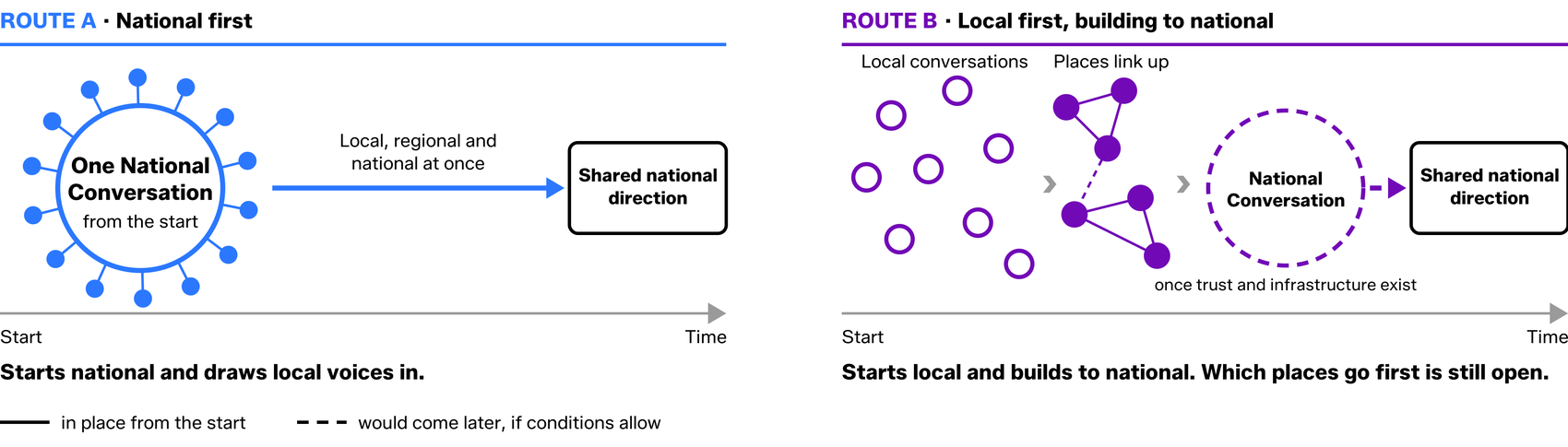
Figure 5. Both routes aim for the same shared national direction; they differ in where they start and how fast a national process forms.
Is Australia ready for the answer it might produce?
Trusting the public means accepting that a National Conversation might land somewhere its designers, funders or political champions would not choose. If everyone must be able to see themselves in the result, the result may say very little. If it says something clear, some will not like it.
What makes it hard. Setting a conversation up to succeed has to be reconciled with the chance that it lands somewhere its designers did not hope for. And what earns federal attention may make a contribution feel too distant to matter locally.
What the Lab is testing. A process designed to find out, not to endorse: leaders gain space only from judgement the public recognises as its own. And agreeing in advance what happens to the answer, through a published decision route and an obligation to respond with reasons, set before anyone takes part.
Radical trust
Whether leaders are prepared to act on an outcome they did not expect.
Meaning versus consensus
Where the line sits between an outcome everyone can live with and one that says nothing.
Follow-through
Whether the skills and the will exist to stay true to what the conversation surfaces.
What would count as a good reason not to proceed? And which route would you take: one National Conversation now, or local conversations first?

Who takes part, and how?
A National Conversation is only as credible as the people it reaches.
Honouring local leadership
Across the country, councils, community organisations and local leaders already run conversations about the future, often with more trust than any national process could claim on day one. Track 4 is asking local leaders whether a National Conversation would be desirable, feasible and ethical, and whether it could be done in a way that honours their work.
The right tool
Whether a National Conversation is the right tool at all, or a different response would serve communities better.
Do local conversations need to connect to a national one?
Most conversations about the future happen locally, and many already work well. Participants asked whether local conversations need to connect to a national one at all, and if so, what would let them add up.
It is primarily about identifying people in community who have existing trust and connections there and finding a way to support them to have local level conversations.
Lab contributor

Who is kept out before a conversation begins?
A National Conversation that only hears from people who already take part would repeat the problem it sets out to solve. Who is in the room is a design decision. Civic engagement has to seek out a diverse audience whose participation may be brief or irregular, rather than take its participants as given.
Can I get there, can I stay, can I play, is the question we should be asking ourselves.
Lab contributor
Leave people unable to take part
Awareness: not knowing a process exists or applies to you, or never being asked. The most often reported barrier in the sources reviewed.
Cost, time, distance: the trip, fixed sessions that clash with care or shift work, and getting there at all.
Venues and language: inaccessible spaces, no plain language materials or easy way to request an interpreter, including Auslan.
Disability: repeated disclosure, arranging support, providing evidence.
Digital access and civic literacy: devices, connection and confidence online, and unequal familiarity with how decisions are made.
Leave people unwilling to take part
Distrust of institutions. Past experiences of discrimination. Stereotyping of particular identities. A sense the process is not for them.
Track 6 maps these through ten public profiles, to check the design speaks to the people it needs, not only those who always take part.
Three stages of universal design
Most efforts to include people stop at getting them through the door. The three stages hold the design to a higher standard: can people get in, can they stay as themselves, and does their contribution carry weight?
Access
Aware: knowing it exists, knowing it applies to someone like me, and having actually been asked.
Reach: being able to get to the place or platform, afford the trip, and complete registration.
In the sources reviewed, awareness is the most often reported barrier, and the one most often designed for last.
Belonging
Stay: remaining present and able to keep taking part. Drop-out belongs here.
Safety: taking part as yourself, without masking or disclosing more than you chose to.
Participation can cause harm. Cultural load, public exposure, online abuse and being asked to debate your own belonging all have to be designed against.
Influence
Voice: contributing in my own way, saying the true thing rather than the safe thing.
Audience: that contribution reaching decision-makers and visibly affecting something.
The two fail separately, and the second fails more often. Voice without audience produces exactly the loss of trust a National Conversation would exist to repair.
| Stage | What it covers | Drawn from |
|---|---|---|
| Access Covers awareness and reach. | Aware: knowing it exists, knowing it applies to someone like me, knowing what taking part involves, and having actually been asked. Reach: being able to get to the place or the platform, afford the trip, and complete registration. In the sources reviewed, awareness is the most often reported barrier, and the one most often designed for last. | NSW Government (n.d.), Levesque et al. (2013), Disability Standards for Education 2005, Brady, Verba and Schlozman (1995), Commissioner for Children and Young People (SA) (2023) |
| Belonging Covers staying and safety. | Stay: remaining present and able to keep taking part, across a single session and across a multi-session commitment. Drop-out belongs here. Safety: being able to take part as yourself, without masking, without disclosing more than you chose to, and without it costing you something afterwards. Participation can cause harm. Cultural load, public exposure, online abuse and being asked to debate your own belonging all have to be designed against. | CAST (2024), OECD (2022) |
| Influence Covers voice and audience. | Voice: contributing in my own way, at my own pace, in the form that suits me, and saying the true thing rather than the safe thing. Audience: that contribution being received intact, carrying the same weight as anyone else’s, reaching decision-makers, and visibly affecting something. The two fail separately, and in the sources reviewed the second fails more often. | European Commission (2022), CAST (2024), IAP2 (2014), Foundations for Tomorrow (2026e) |
The Universal Design Ladder
Where something cannot be offered to everyone by default, the Ladder sets the order in which other options are tried, so the cost of access falls on the process rather than the person. Each step down transfers work, cost and exposure from the process to the person, so a step down is taken only when the step above cannot be met.
Built in for everyone. Nobody asks, nobody discloses, nobody waits.
Example: accessible venues selected for every in-person session, and materials shared in plain language ahead of time.Offered to everyone as a standing choice, rather than the person having to determine the fix.
Example: registration offers opt-in and opt-out tick boxes for additional supporting formats.Available, but the participant must ask. State what, when and how.
Example: requests for an Auslan interpreter submitted through a visible, low-burden process.Access depends on another person's decision. Legitimate only where law or safeguarding requires it.
Example: a participant requests a support worker who will be present in sessions that include people under 18.Built in for everyone. Nobody asks, nobody discloses, nobody waits.
Offered to everyone as a standing choice to enable participation through the method that suits best, rather than the person having to determine the fix.
Available, but the participant must ask. State what, when and how.
Access depends on another person’s decision. Legitimate only where law or safeguarding requires it.
Run every stage of taking part through the Ladder
START HERE ↓
Built in for everyone. Nobody asks, nobody discloses, nobody waits.
Offered to everyone as a standing choice to enable participation through the method that suits best.
Available, but the participant must ask. State what, when and how.
Access depends on another person’s decision. Legitimate only where law or safeguarding requires it.
Who a National Conversation has to reach
Ten profiles represent the main groups the Lab needs to reach. They are not exhaustive, and some Australians may sit beyond what this project can reach with the time and resources available.

Australians who think the country can still be improved and are actively working towards improving it.
Those who keep the work moving from inside the machinery, persisting in the face of institutions that are slow to move.
Those who have seen enough good ideas fall over to know what it takes.
Those who hold their communities together, and have been 'engaged' so often that they are left fatigued.
Those already carrying the cost of systems that were not built with their interests in mind, often while doing the work that keeps the country running.
Those who made this country their home by choice, and know better than most what it means to belong.
Those who value settings that have proven themselves, and believe change should be careful and earned.
Those working to build a life, holding it all together for the people who rely on them.
Those who have watched politics promise and fail often enough to tune out, and will only lean in when something real is on the table.
Those still trying to get a foothold, whether just starting out or starting again, looking for a way through.
Does more technology mean more voice?
Digital platforms promise wide reach at low cost. But reach, volume and representativeness measure different things: reach is how many people knew a process was happening, volume is how many took part, and representativeness is whether they resemble the country.
What Track 3 is testing. A hybrid, treating the offline, face-to-face pathway as an equal to the digital one, not a fallback. Synthesis people can inspect: Taiwan's vTaiwan process grouped participants by how they voted on each other's statements, so anyone could see how agreement was found. And disclosure before the first pilot, since national-scale synthesis is likely to involve some automated analysis.
Reach
Who a platform brings in that would not otherwise take part, and who it leaves out.
Synthesis
Whether large volumes of input can become something decision-makers can use, and whose judgement shapes that summary.
Trust
Whether participants can see where their contribution went, whatever the technology behind it.
Menu of in-person and digital engagement options
No single channel reaches everyone. The menu sets out how people could take part, from face to face to fully digital, with international case studies mapped to each tier.
Links input, synthesis, policy tracking and accountability in one owned system. No single precedent; assembled from parts.
Singapore REACH, Brazil Transparency Portal, Taiwan Join
Verification and authentication layer, not itself deliberative. Years to build.
Estonia e-ID and X-Road, Ukraine Diia, Chile Clave Única
Platform plus real analytical capability. A two-way loop between citizens and process.
vTaiwan and Pol.is, Chile online consultation data processing, Ireland Mi-Voice
Configurable SaaS. Structured input collection at moderate scale, needs a facilitation layer.
Spain Decidim, Hamburg DIPAS, Norway citizen panel, Iceland Better Reykjavik
Off-the-shelf social and messaging platforms. Wide reach, weak synthesis and feedback loop.
India MyGov WhatsApp, Finland #suomikuvahaaste, Wales #futurecymru
Physical distribution, manual collection and coding. Census-like reach, no digital access required.
Canada TRC statement gathering, Wales postcards and drawings, Finland Espoo benches
| Tier | Option | What it is | Relevant case studies |
|---|---|---|---|
| 6 MOST TECHNICAL | Fully custom, integrated platform | Links input, synthesis, policy tracking and accountability in one owned system. | Singapore REACH, Brazil Transparency Portal, Taiwan Join. No single precedent; assembled from parts. |
| 5 | Identity-linked national infrastructure | Verification and authentication layer, not itself deliberative. Years to build. | Estonia e-ID and X-Road, Ukraine Diia, Chile Clave Única |
| 4 | Structured deliberation and synthesis | Platform plus real analytical capability. A two-way loop between citizens and process. | vTaiwan and Pol.is, Chile online consultation data processing, Ireland Mi-Voice |
| 3 | Licensed engagement platform | Configurable SaaS. Structured input collection at moderate scale, needs a facilitation layer. | Spain Decidim, Hamburg DIPAS, Norway citizen panel, Iceland Better Reykjavik, Canada digital statement submissions |
| 2 | Broadcast and campaign channels | Off-the-shelf social and messaging platforms. Wide reach, weak synthesis and feedback loop. | India MyGov WhatsApp, Finland #suomikuvahaaste photo challenge, Wales #futurecymru |
| 1 LEAST TECHNICAL | In person, paper and analogue | Physical distribution, manual collection and coding. Census-like reach, no digital access required. | Canada TRC statement gathering, Wales postcards and drawings, Finland Espoo benches |
Who is kept out before a conversation begins, in the communities you know? And what would make the difference?

How do many voices become a decision?
Hearing from many people is only half the task. The harder half is turning what they say into something a decision can be tested against.
Premise of criteria
Output 2 rests on an idea still being tested: that the public can set the conditions a decision must meet without making the decision itself.
How, not what? Some criteria could settle an argument before it starts. A draft criterion such as 'precaution against irreversible harm' could decide much of a climate or land-use question on its own. Who should draw that line, and how would you know it had been crossed?
Why criteria, not a list of preferences
A criterion is a question every long-term decision must answer, such as who carries the cost and for how long. A view on one policy says nothing about the next.
- Contributions could add up. A community hall in Darwin, a phone survey in Geelong and a Treasury workshop could feed one national result if each tests the same criterion.
- It could help meet an existing duty. Since December 2024 the Public Service Act 1999 has required the APS to support the public interest now and into the future.
- Rejection is a finding too. If the public consistently declines to rank a criterion as important, a justification resting on it is unlikely to persuade.
How a zone of public tolerance works
A zone of public tolerance records the conditions under which people accept a cost. It sets no price.
Burden distribution across generations
Who carries the costs and who receives the benefits, across generations and within them?
Problem solving
Participants weigh a named cost. For example, spreading the cost of infrastructure for new housing across decades of borrowing.
Conditions for accepting the cost
The assets outlast the repayments. Repayments are reported publicly. The people who repay also use the assets.
Meets, or breaches
Meeting the conditions is provisional evidence of informed public judgement. Breaching one triggers review, in a form not yet decided.
Who carries the costs and who receives the benefits, across generations and within them?
Participants weigh a named cost. For example, spreading the cost of infrastructure for new housing across decades of borrowing.
- The assets outlast the repayments.
- Repayments are reported publicly.
- The people who repay also use the assets.
Figure 6. How a zone works, using an illustrative housing example. The conditions shown are hypothetical. Still open: how zones are set and validated, and what form review takes when a decision breaches one.
Are 'trade-offs' essential, or accepting scarcity too soon?
Many decisions about the future involve giving something up, though acting early can sometimes remove the need to. A conversation that avoids trade-offs can leave everything to be settled later. Contributors disagree about the language.
Everyone wants to go to heaven but no one wants to die. People don't realise they are linked.
Lab contributor
It prompts a scarcity mindset
Participants in several Tracks felt the word prompts a scarcity mindset, and preferred language about impact, causation and what leaders should stand for.
Naming costs is a mark of credibility
Practitioners and government representatives saw naming costs as a mark of credibility. Agreement in the abstract is cheap: principles such as fairness between generations attract broad support, and the difficulty appears when a principle meets a cost.
Candidate words being weighed
'Trade-offs' remains the technical term. Whichever word is chosen with participants must still ask them to name a cost. Candidates include: hard choices, competing goods, conscious choices, weighing what matters, what we are willing to give up, and priorities under constraint. A softer word risks weakening the question until it no longer names a cost.
Name the cost, without fixing the trade-off
The working position is that a National Conversation should name each cost, who carries it and who decides, without fixing the trade-off in advance. Eight objections were raised in the workshops, each with a draft design rule in response.
We don't have to commit to a zero sum game, but we must grapple with trade-offs. Trade-offs exist even if it is not a zero sum game.
Lab contributor
Objection
Talk of loss narrows thinking. Trade-off language can trigger a scarcity mindset that crowds out the long view.
Draft rule
No cost at civic imagination. Early questions never ask people to choose between groups or accept a cost. Constraints enter later, as assumptions people can contest.
Fixed trade-offs hide better options. Opening with a trade-off can miss options that would remove the need to trade at all.
Necessity before settlement. The design asks whether a trade is necessary before it asks how to settle one.
A named trade-off can become a licence for harm. 'There was no alternative' is used as a justification as often as a finding.
A test, never a licence. Criteria set tests a decision must pass before a loss is imposed, and the record states what was protected.
Some things must not be priced. Asking people to weigh a sacred value against money produces outrage, not answers.
Non-negotiables come first. A decision that fails to protect a non-negotiable fails, however well it weighs trade-offs.
It can divide people alive today. A conversation built around who loses now sets groups against each other.
No question presumes people go without essentials. No question asks participants to accept that others will go without a home, care or safety.
It can undo the long-term vision. Testing a vision against short-term trade-offs lets short-term interests win again.
Conditions made explicit. People are asked to state the conditions they attach to their aspirations.
It can repackage old compromises. Framing decisions as trade-offs can repeat the compromises that produced today's problems.
Constraints are broader than money. Workforce, time, land, attention and political capital bind decisions however spending is financed.
It can justify decisions already made. A tool that records trade-offs after the fact can defend a decision but not shape it.
Direction-neutral instruments. Cards are designed so that choosing one does not signal which way a participant leans.
What has to exist first
People can weigh a real trade-off more readily when some shared foundations are in place. Whether a National Conversation builds these before it runs, alongside it, or later is unresolved.
A trusted information environment
Regional media and research written for a general audience.
Civics and adult education
A working sense of how decisions actually get made.
A shared factual ground
Facts settled before the debate, so it turns on the choices before us, not the numbers.
A habit of constructive deliberation
About the long term, built alongside the process.
Local trust built on reciprocity
Repaired first where government has been extractive.
Can the public set the conditions a decision must meet without making the decision itself? And which word would you use with participants instead of 'trade-offs'?

Will it make a difference?
Australians have been consulted many times and often seen little change.
Where does the line from voice to decision break?
Many people know the experience of making a submission and never hearing what came of it. A National Conversation could only earn participation if people can see where their input went.
The country continues slowly drifting away from what the people want and towards what the powerful want.
Lab contributor
Tensions being worked through
- Commitment to listen, or commitment to act. Asking government to commit to act risks refusal; asking only that it listens is achievable.
- Independence, or policy relevance. The more independent the process, the harder a policy response is to secure; the closer to government, the more its legitimacy is questioned.
- Feedback that scales. Consultation fatigue comes partly from engagement that never reports back. The working position is one guaranteed return to every participant.
- A third option being explored. Between listening and acting sits an obligation to respond: to consider findings on the record and give reasons.
Obligation
Whether whoever receives the output must respond formally, in public, and while decisions are still being made.
Visibility
Whether people can see who narrows their input, and under what rule.
Durability
Whether commitments survive a change of government, or reset with every election.
How a National Conversation could intercept a vicious cycle
Long-term policies impose visible costs now for uncertain gains later. Informed public judgement could change that calculation, lowering the political risk of acting.
What keeps the loop turning
- Investment that outlasts one process. Capability is lost when engagement winds down. Output 3 would keep it in use between conversations.
- Feedback closed every time. People who see what happened to their input are more likely to take part again. Consultation fatigue can start where they do not.
- A process designed to find out, not to endorse. Engagement seen as predetermined raises political risk.
Why this could work. Most Australians want a greater say: 65% want ordinary citizens to have a much greater say in setting core policy priorities (Centre for Policy Development, 2026). And deliberation can give leaders room to move: Ireland's Citizens' Assembly let a governing party consider a contested constitutional question before taking a position.
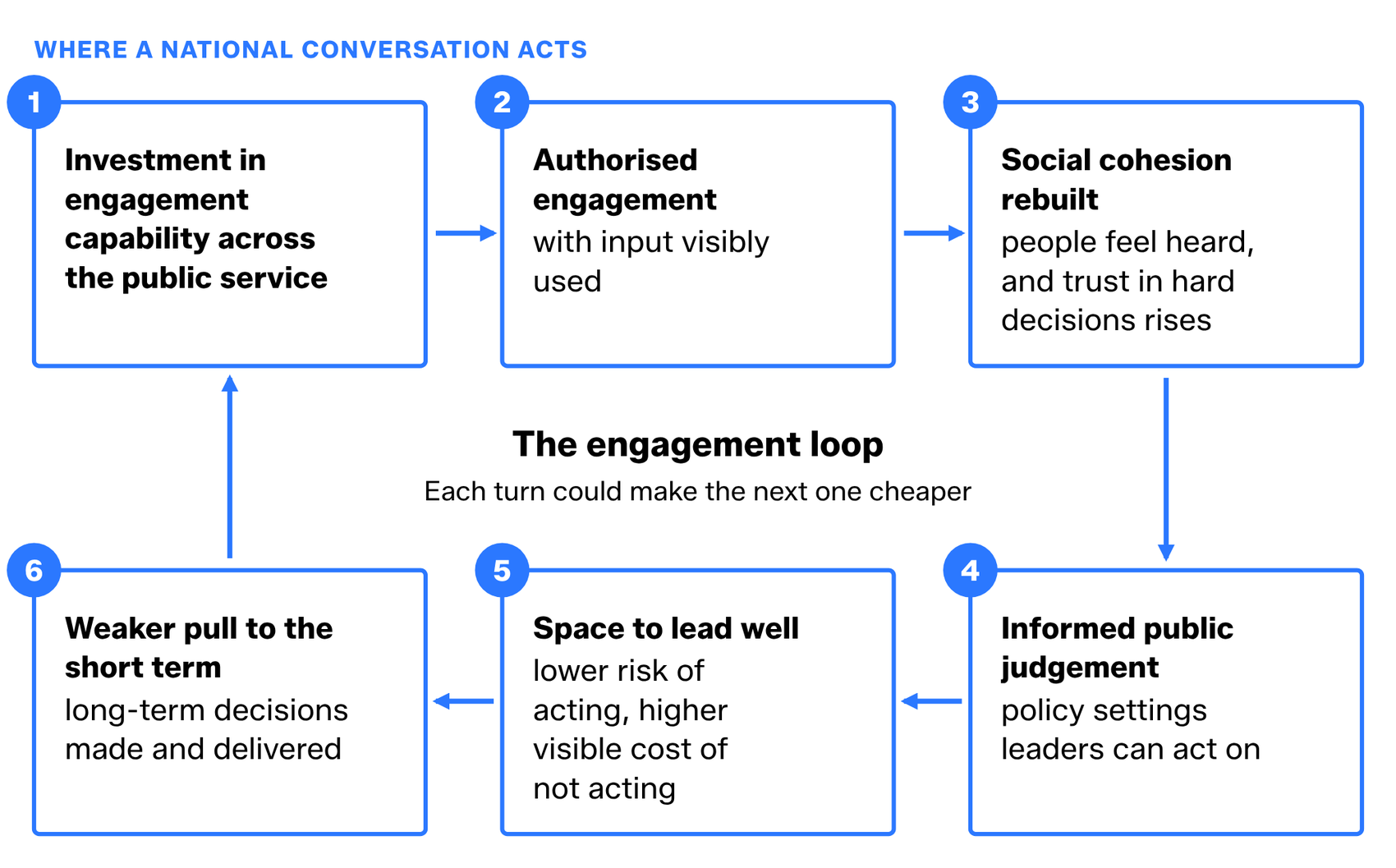
Figure 7. The engagement loop being tested: authorised engagement, visibly used, could make each long-term decision less risky than the last. Source: Track 2: Research design, data and ethics (2026).
Commissioning and delivery models
The first break comes at the start, when no one with authority is obliged to answer. A well-designed conversation still needs someone with the standing to call it, and someone obliged to respond.
Run by one national body
Government-run
A department, commission or statutory body designs, funds, runs and reports through government.
Strengths: direct route into budget and legislation, with resourcing, data and reach from commencement.
Constraints: independence is contested, scope is set by the government of the day, and continuity is tied to the electoral cycle.
Parliament-commissioned
Parliament sets the question by resolution and delegates delivery to an independent body, under terms fixed before commencement.
Strengths: aims to outlast a change of government. A response obligation can be drafted into the commission.
Constraints: the obligation exists only if written into the terms, and funding depends on the government.
Shared mandate, single body
Government or parliament and a community coalition co-sign the terms. One body runs the process under them.
Strengths: legitimacy on both sides, and a decision route agreed before participation is sought.
Constraints: negotiation is slow and can fail publicly.
Independent convenor
A civil society body designs and runs the process. Government receives the output without owning it.
Strengths: independence is demonstrable. Work commences without a government decision.
Constraints: no party carries a response obligation. Legitimacy and funding are built from the base.
Run by many local organisations
Community seed grants
Government sets a common design and funds local organisations to deliver it in their own places.
Strengths: reach into places a national body cannot access, with local trust carrying recruitment.
Constraints: quality varies between hosts, and delivery risk sits with local organisations.
Parliament-commissioned, locally hosted
Parliament sets the question and the response obligation. Local organisations host the conversations.
Strengths: multipartisan cover combined with local reach.
Constraints: no precedent outside constitutional transitions.
Shared mandate, locally delivered
Terms co-signed before commencement, delivery held by local hosts, reception written into a standing parliamentary mechanism.
Strengths: on early mapping, the one position that may address all three failure points.
Constraints: highest assembly cost, longest lead time, untested end to end.
Community conversations
Multiple organisations run conversations under a shared framework and pool findings. Ownership is distributed.
Strengths: scale at low central delivery cost, and continuity through a change of government.
Constraints: consistency between partners is difficult to hold and ownership of findings is contestable.
The shape of the engagement
Every engagement widens and narrows. The second break comes in the middle, when many voices are narrowed out of view. Five common patterns, none of them chosen:
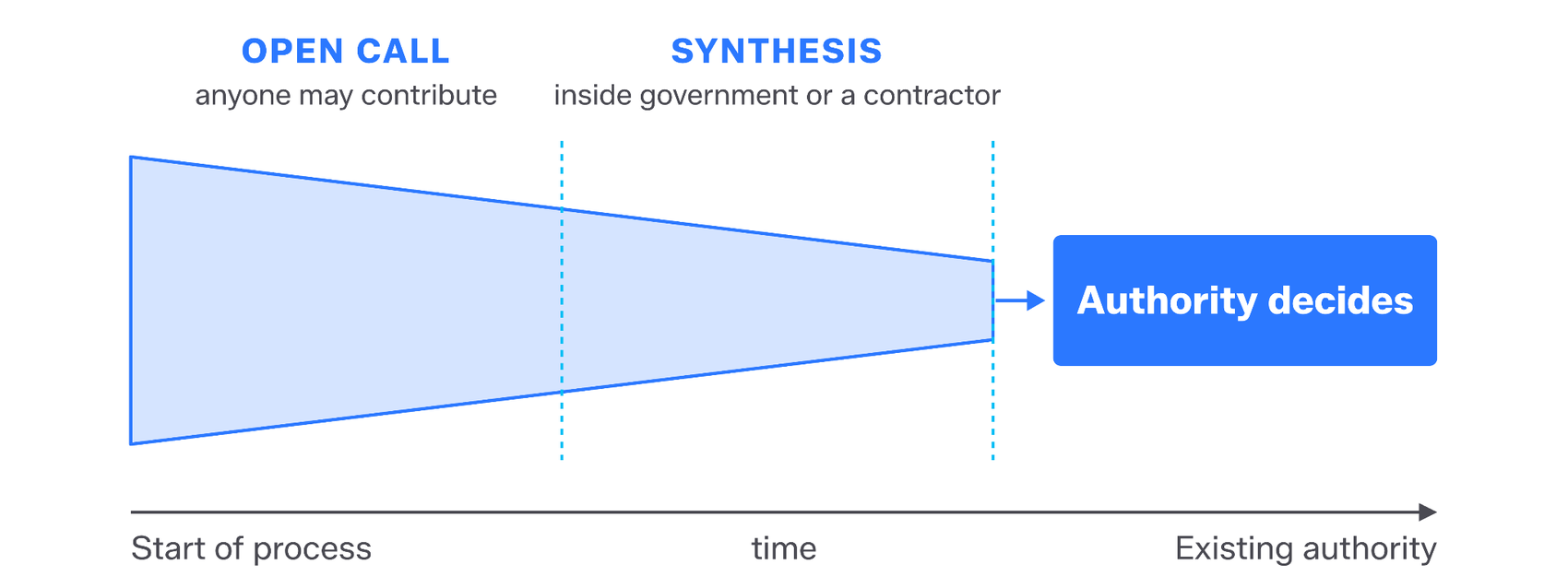
Anyone can contribute, then synthesis happens out of view and an existing authority decides.
Delivers: wide, visible reach at low cost per person. Costs: narrowing happens out of view, so people cannot trace their input.
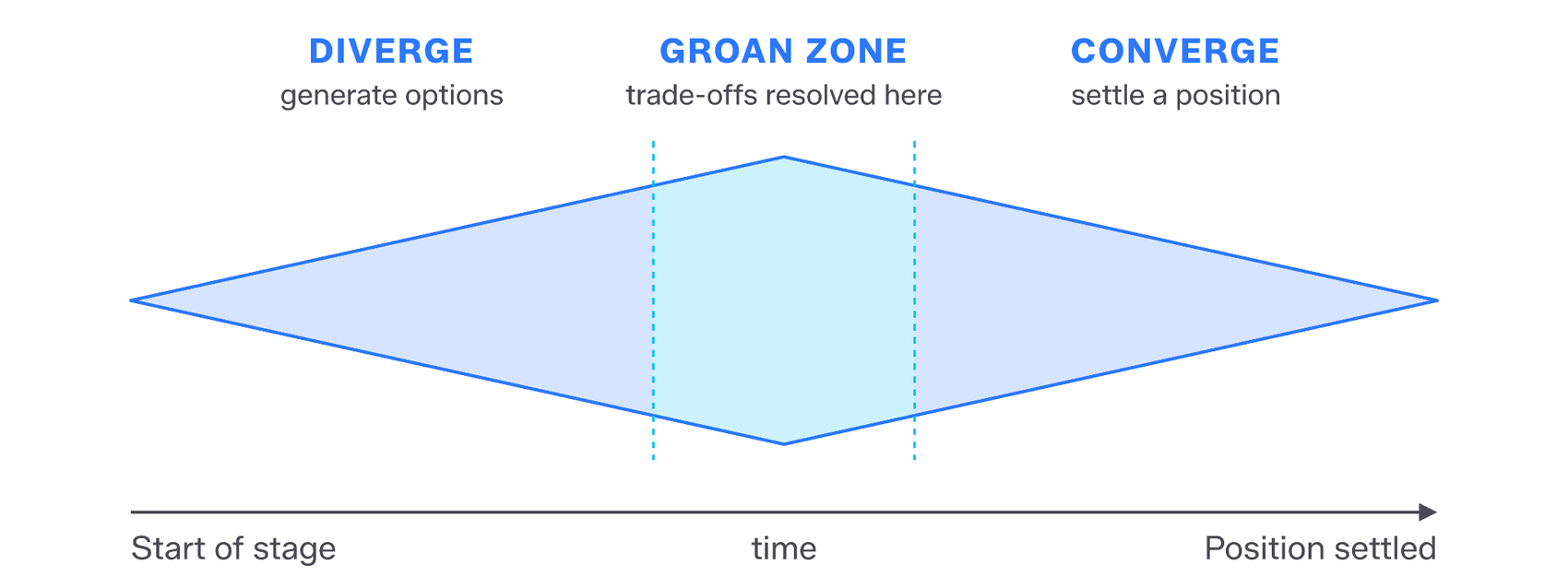
The same people generate options, work through trade-offs in the middle, then settle a position.
Delivers: time to work through trade-offs together. Costs: works inside one stage, and the middle has to be resourced deliberately.
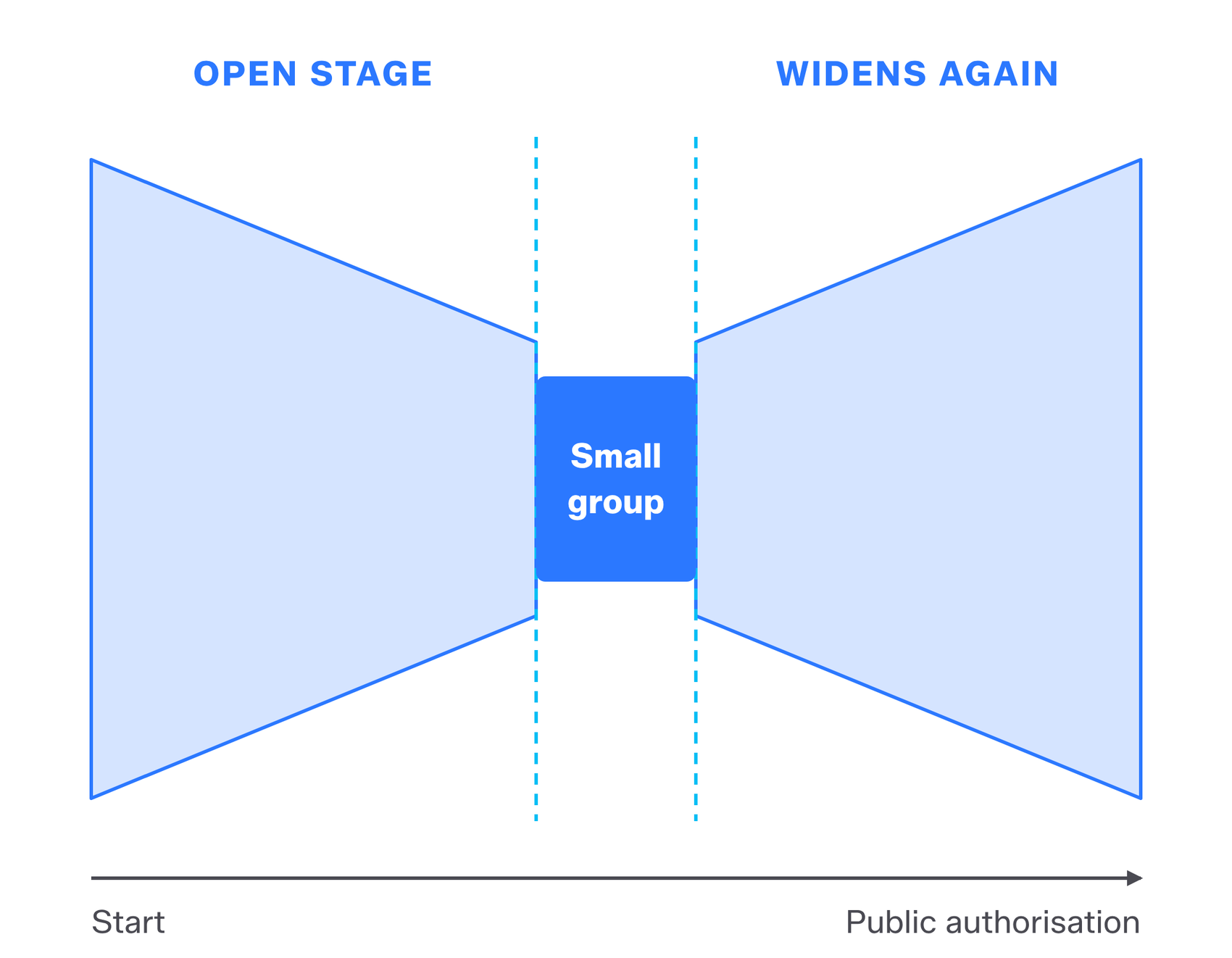
A wide-open stage narrows to a small representative body, then widens again for public authorisation.
Delivers: the one shape of the five that aims to produce both considered judgement and public authorisation. Costs: likely the most expensive and fragile.
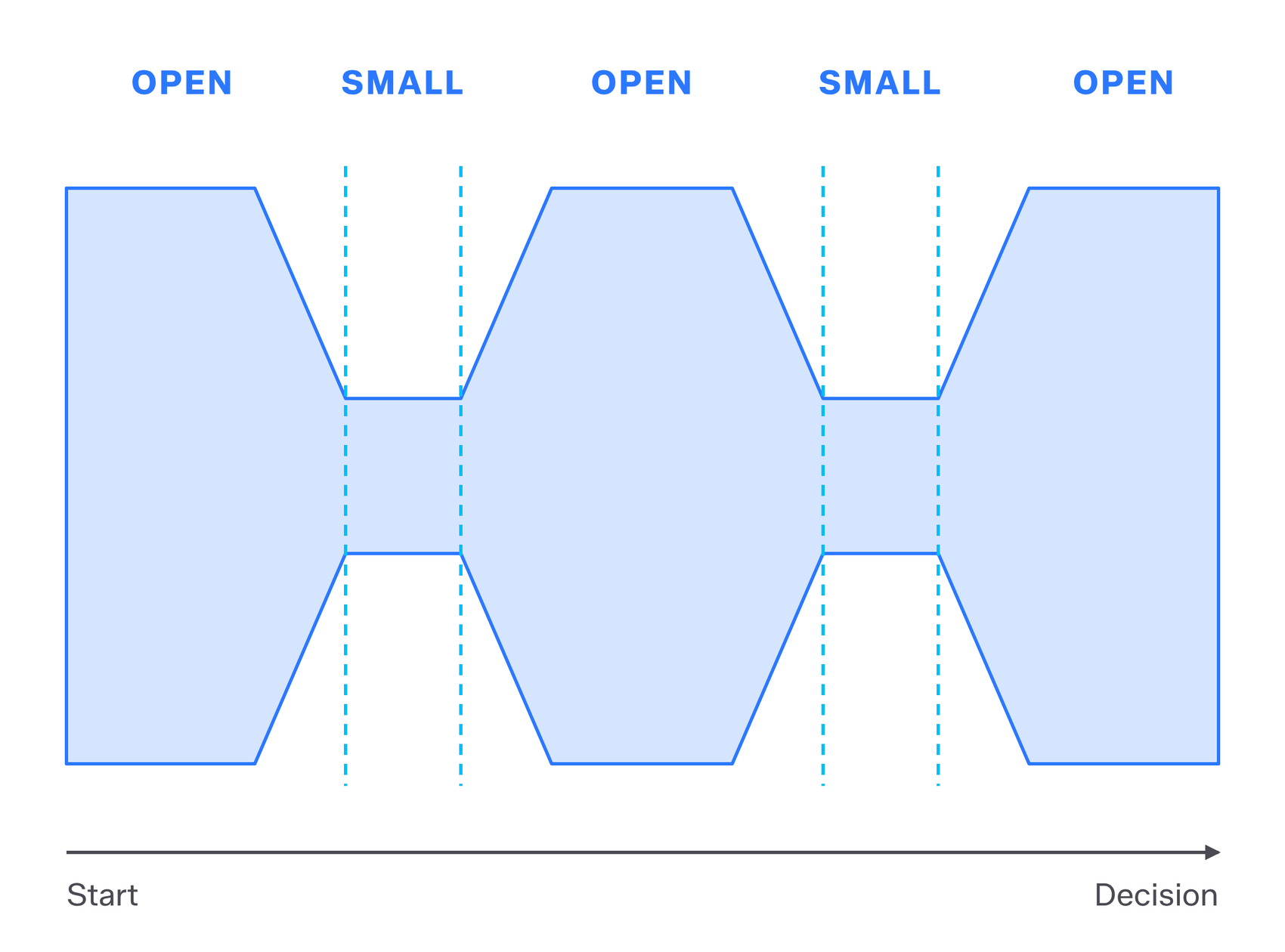
Open stages alternate with small groups, each open stage reviewing what the last small group produced.
Delivers: no single narrowing carries all the risk. Costs: every narrowing needs its own published rule.
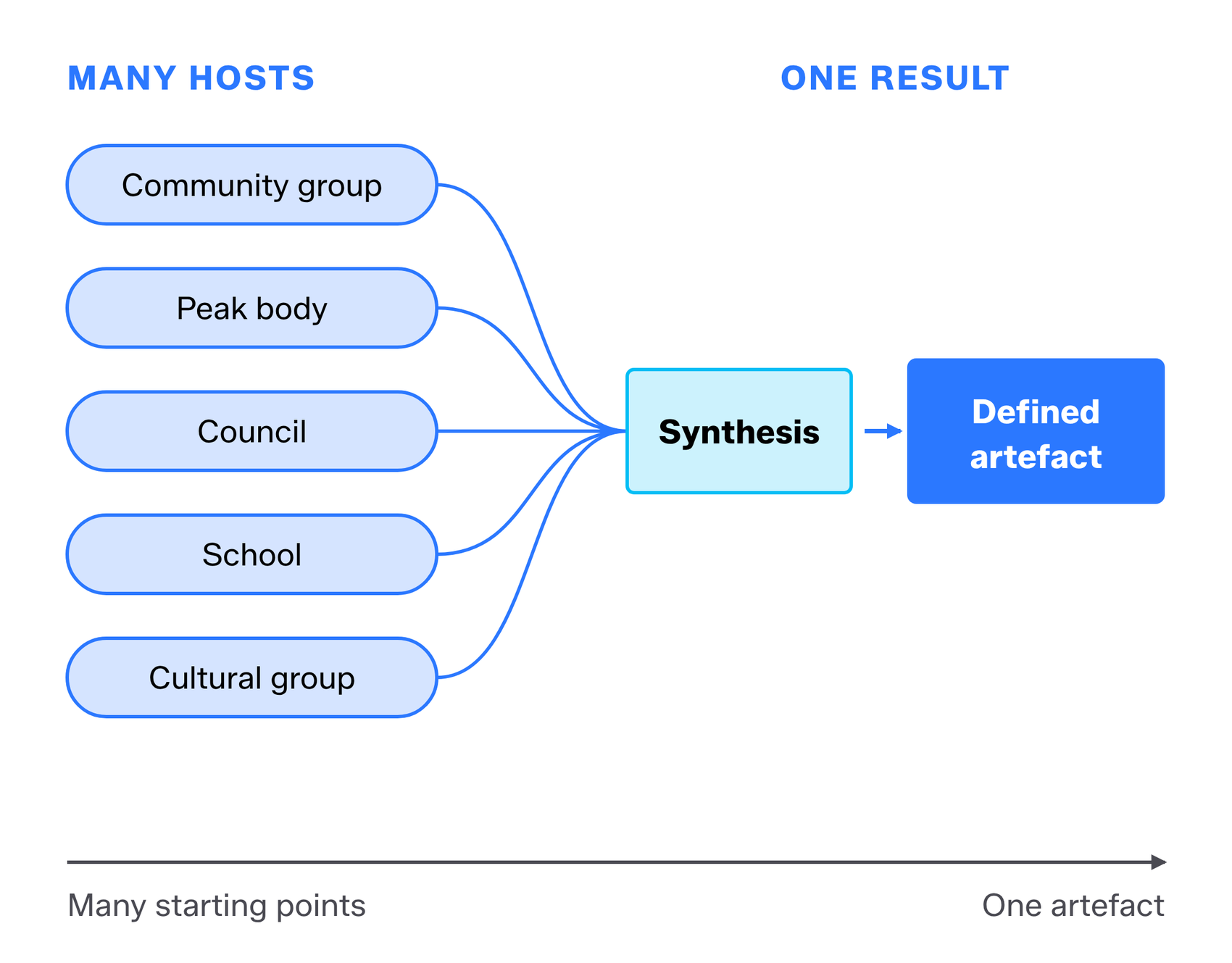
Many parallel conversations, each under its own banner, narrow through synthesis into a defined artefact, not through selection of people.
Delivers: reaches people through hosts they already trust. Costs: results vary with each host and facilitator.
The bow tie, one of five shapes being weighed. The tension throughout is visibility against cost: the cheapest shapes reach many people but narrow out of public view.

Building authority
The third break comes at the end, when commitments reset with each election. Six draft building blocks for the authority to act on what a National Conversation produces:
Model design
A published model that specifies the decision route before preferences are sought.
In place when: a published model names the receiving body and the response obligation it will seek.
Coalition building
A community counterparty with standing and reach to hold authority alongside government.
In place when: a standing coalition has an agreed procedure for mandating a signatory.
Terms of reference
A written instrument, negotiated in public and signed by both parties, fixing scope and decision rights before participation is sought.
In place when: a signed instrument fixes scope, decision rights and the response obligation.
Resourcing
Parties critical to delivery have access to, and agency over, the resources required.
In place when: funding is allocated to hosts for the full duration, and the allocation is published.
Engagement
The conversation delivered through local hosts to a shared design, under the terms of reference.
In place when: findings are comparable across sites and participants can see the terms of reference.
Consideration and response
An obligation on a multipartisan mechanism to consider findings on the record and account for what it does with them.
In place when: reasons are given for any recommendation declined or modified within a defined period.
Which commissioning model would you back, and which shape of engagement? Where have you seen the line from voice to decision break?
Prototype
Most public debate argues about decisions and never reaches the criteria behind them. The criteria deck, an early tool being tested with participants, turns Output 2 into something people can hold in their hands.
The criteria deck
A card deck for weighing the criteria that shape decisions.
Policy decisions rest on criteria, and many of them go unstated. Which criteria are applied, and how conflicts between them are resolved, shapes what a decision does. The criteria deck brings that layer into the open: seventy-five criteria for good decision-making, drawn from Australian practice and international governance frameworks.
Select a card to turn it over.
Legitimacyvoice
Fair sharesfairness
Social contractresponsibility
Problem definitionevidence
Timelinessdelivery
Intergenerational fairnessfuture
Stabilityendurance
Wildcardwildcard
One card from each of the seven suits, plus a wildcard. The deck holds seventy-five criteria in total.
Figure 8. Draft cards from the prototype deck. Each card names a criterion, the question it asks, and where a good decision can still fall short.
A participatory way to weigh criteria
Participants decide which criteria they want shaping decisions, rather than responding to options framed in advance by others.
Understanding of the tensions
Each card identifies the criteria it most often pulls against. Working with the cards is meant to show how deliberation handles conflict.
Faster conversations about criteria
The cards give a group a shared vocabulary for concepts that would otherwise take a long time to define, so a single session can get further.
Insight into public preferences
Patterns across sessions, including which criteria are prioritised and how tensions are resolved, build a picture of the public interest.
What each card carries
- Suit. The group the card belongs to, shown by name, icon and colour.
- Criterion name. The name of the criterion being tested.
- Question. A plain English question to ask out loud about the decision.
- Definition. A one-sentence test a decision can be held against.
- Example. Where an otherwise good decision would fall short on this criterion.
- May pull against. The criteria most likely to come into tension with this one.
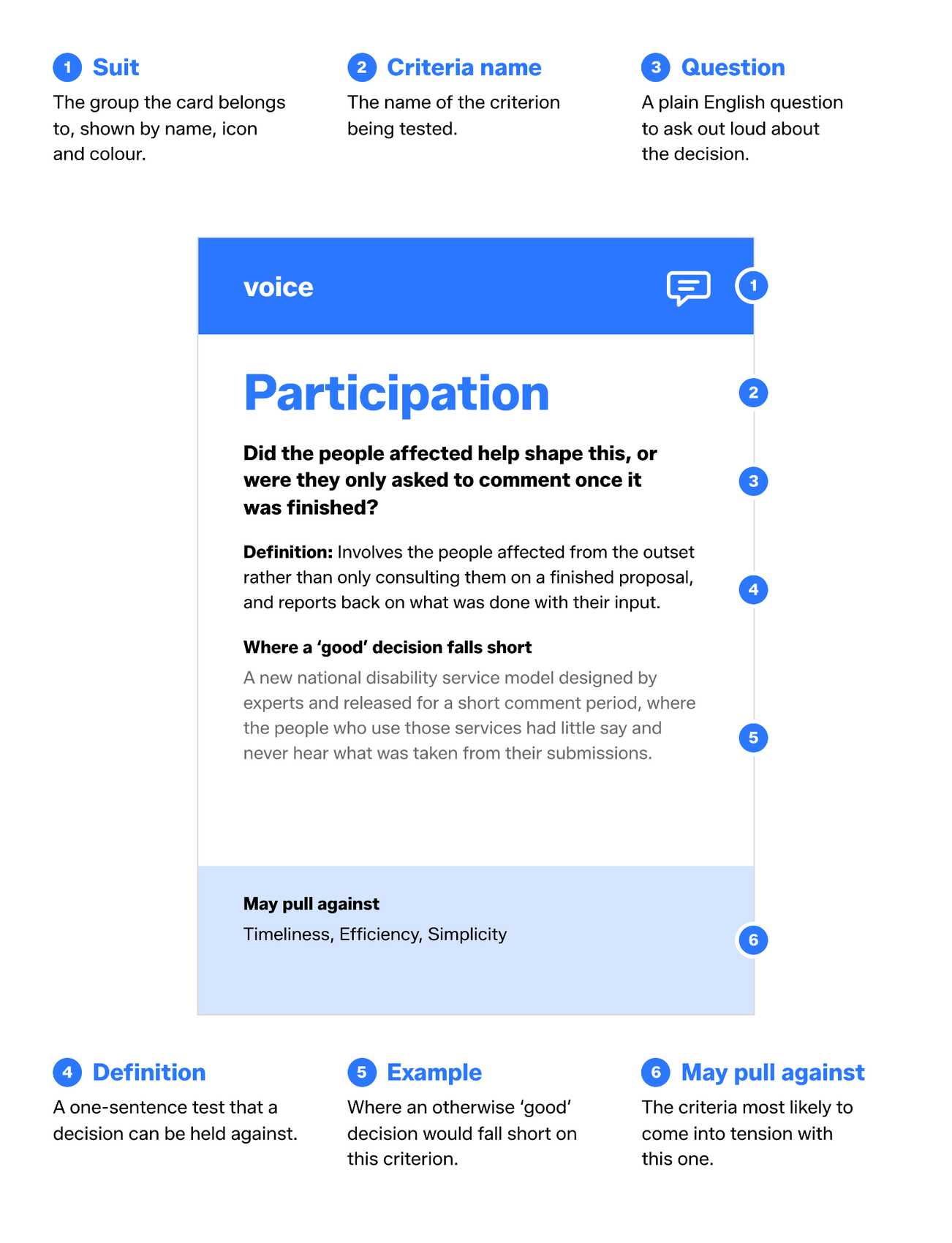
What test is missing from the deck? Name it in three words or fewer. If a decision went wrong, what would you say it failed to consider? Which card would you trade away?
Reference
Terms used throughout this report, how the Lab is governed, and the sources behind it, so readers can respond to the substance without first decoding the language.
Glossary
Short definitions of the structures, roles, documents and terms named in this report.
How the Lab is organised
The Lab's deliberative body, providing strategic direction and integrity guardianship. Its authority is deliberative; legal and fiduciary authority rests with the FFT Board.
The home for ethics, research practice and conduct across all six Development Tracks, with two subcommittees.
Composed exclusively of First Peoples, it holds authority over data involving First Nations knowledge.
Guides the intercultural protocols of the Lab.
The six workstreams of the Lab's design work, running at the same time and feeding into one another: government and policy integration; research design, data and ethics; engagement design and technology; community-led design; accessibility and inclusion; and public engagement.
Subject-matter experts who lead each Track, give strategic guidance and review track materials before they reach the full membership.
Individuals or organisations working directly inside one or more Development Tracks over the life of the Lab, through the kick-off and four workshops.
Subject-matter experts who contribute across the Tracks rather than inside one, at the depth of a Core Partner, on terms shaped case by case.
Experts and leaders who stay close to the design without attending live sessions, reviewing outputs and giving ad hoc advice.
Councils, community organisations, youth groups and local leaders who connect their networks, take part in engagement and may host pilots.
The four cycles of design work between August 2026 and mid-2027, each built around a workshop and each building on what the last one learned.
Tests of elements of the model with everyday Australians, run by community leaders, civil society organisations and parliamentarians.
The document that sets out how the Lab is governed, its strategic objectives and its operating principles.
A group of parliamentarians from both houses, convened by FFT, and one of the first readers of this report.
Terms used in this report
A large-scale, structured, collaborative process that would bring everyday Australians together to explore what matters most and identify what is shared.
The National Conversation Development Lab: the participatory design process developing and testing a model for a National Conversation. It is not the National Conversation itself.
Describes how the Lab works: people shape the design as it develops, rather than being consulted on a finished proposal.
The Lab's working design document for the model, drawing on all six Development Tracks.
The three kinds of lasting value the design aims for: community visioning, public interest stewardship, and durable and adaptive governance.
People imagining a shared future and disagreeing well, building networks and civic capability that outlast any single decision.
Communities defining the public interest as criteria to guide long-term decision-making.
Laying the building blocks, over time, for national coordination infrastructure as a public good.
The three stages a National Conversation would move through over time: orientation and grounding, synthesis and design, and substance and debate.
Three depths of engagement that run at once, each trading reach for depth: civic imagination, problem solving and institutional design.
Draft questions that every long-term decision would answer, to be set by the public and designed to hold across policy areas.
The four tests a National Conversation would need to pass before it proceeds: whether it is desirable, feasible and ethical, and whether it will have an impact.
The conditions under which the public would accept a cost from a decision. It records conditions, not a price.
Giving one thing up to gain another, often something now for something later. Whether to use the word with participants is still open.
A tension raised by participants and set out for readers to respond to.
Designing for everyone from the start, so people do not have to ask, disclose or wait to take part.
The order in which access options are tried when something cannot be offered to everyone by default.
Track 4's conversations with local leaders about whether a National Conversation would be desirable, feasible and ethical.
What the Lab is building now, the larger pathway if conditions allow, and the value that remains with or without a full National Conversation.
Draft measures of whether a National Conversation worked, defined before anything is built.
A prototype card deck for weighing the criteria that shape decisions and seeing where they pull against each other.
The collaborative leadership model
The model brings partners, advisors and communities into how the Lab is run, under shared principles, so that its outputs are developed with the people they are meant to serve.
Governance Council and Lab Charter
Convened by Foundations for Tomorrow. Co-chairs and core partners work beneath it, across the six Development Tracks.
Research Ethics and Cultural Integrity Group
The home for ethics, research practice and conduct across all six Tracks, with the First Nations Data Sovereignty and Intercultural Engagement and Ethics subcommittees.
Networks and Fellows
The Expert Advisory Network, the Future Generations Fellows and the Community Network all feed into the six Development Tracks.
The principles that underpin the model
Non-partisan inclusion
Political independence is a condition of the Lab's legitimacy. The Lab has no alignment to any political party or ideological tradition.
Universal design
To serve the best interests of Australians across geographies, generations, cultural backgrounds, political traditions and circumstances.
Process focus
The Lab is about how Australia decides, not what it decides. It does not advocate for policy positions in areas such as housing, climate or health.
Accountability
Accountable to communities, partners, funders and the public for the integrity of its work, through transparent decision rationales.
Quality over scale
Reaching more people by sacrificing process quality reproduces the consultation fatigue the Lab is designed to address.
Evidence-based practice
Driven by evidence-based dialogue and decision-making, including peer-reviewed research, government data and professional practice.
Mutual respect and curiosity
Surfacing the full range of insights in the room, rather than advocating for one's own position.
Strengths-based engagement
Approaching communities and participants from their capabilities, knowledge and aspirations.
Culturally responsive design
Engaging through methods, language and protocols suited to context. Intercultural, intergenerational and First Nations protocols guide the work.
These descriptions have been streamlined. The full principles are available in the Lab's Charter.
References
Lab outputs and other sources cited in this report. The full reference list, with every citation, is in the PDF.
Brady, H., Verba, S. and Schlozman, K. (1995) Beyond SES: A Resource Model of Political Participation.
CAST (2024) Universal Design for Learning Guidelines.
Centre for Policy Development (2026) Survey on citizen participation in setting policy priorities.
Commissioner for Children and Young People (SA) (2023).
Disability Standards for Education 2005 (Cth).
European Commission (2022) Guidance on citizen engagement.
Fiske, A. P. and Tetlock, P. E. (1997) Taboo trade-offs: reactions to transactions that transgress the spheres of justice.
Foundations for Tomorrow (2026a–e) Lab Development Track outputs.
IAP2 (2014) Public Participation Spectrum.
Levesque, J. et al. (2013) Patient-centred access to health care.
Local Government Act 2020 (Vic).
NSW Government (n.d.) Engagement guidance.
OECD (2022) Building Trust to Reinforce Democracy.
Public Service Act 1999 (Cth).
Queensland Plan Act 2014 (Qld).
Australian Public Service Commission (2025) APS Employee Census.
Everything here goes into Workshop 2
Everything in this book goes into Workshop 2 on 17 and 19 November 2026, where testing begins. Your responses will shape which ideas hold, which bend and which are rethought.
Early thinking from design cycle 1, open for response.
Testing early findings: what holds, what bends and what needs rethinking.
Research, roundtables and community pilots.
A tested model delivered to parliamentary leaders.
How to respond
Questions for you appear throughout this report. Answer one, several or all of them, or tell us what we have missed. Responses received by Friday 6 November 2026 will shape what is tested at Workshop 2.
Send a response, a document or a question.
Share thoughts as the design develops.
Community pilots will test elements of the model with everyday Australians. Could you host one in your electorate, organisation or community?
Hawkins, T. D. and Hall, E. (2026) Building the Australia We Want: Interim insights from the National Conversation Development Lab. Foundations for Tomorrow Ltd, October 2026.